A Summary by Savannah Sanders
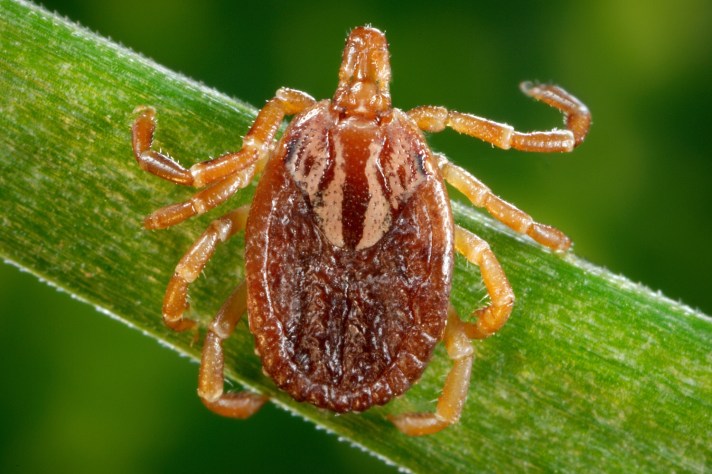
Image from wbur.org
Colorado Tick fever virus (CTF) has been found recently in a few cases in Oregon. According to the many authors who wrote the article “Notes from the Field: Investigation of Colorado Tick Fever Virus Disease Cases — Oregon, 2018”, “Over the past decade, the Oregon Health Authority has reported an average of less than one case of CTF per year.” (McDonald E, George D, Rekant S, et al., 2019) It has only been recently that four cases of CTF has been found in Oregon in 2018 and in a radius of 540 square miles in central Oregon. All four cases where reported at an elevation of 4,000–10,000 above sea level.
CTF virus is a coltivisus and is part of the family of Reoviridae, a small family of viruses composed of RNA. CTF is considered a arthropod-borne disease, which means that the virus is contractible from one live host to another. The coltivirus uses the wood tick as a reservoir before infecting the animals that the tick feeds on. Once in the body of the infected host. The coltivirus can either stay isolated from red blood cells, or it can infect the host bone marrow. Once the infection of the virus is in the bone marrow of the host, the virus can persist thought the lifespan of the red blood cell, in which is it protected from antibody’s of the immune system.
Symptoms of the virus include leukopenia, thrombocytopenia, fever, and rash. There is no known treatment for CTF virus, and in some cases can lead to hospitalization or death. All four of the reported victims in Oregon where reported to be bit by a tick previous to falling ill. Three out of four of the victims where hospitalized, treated with doxycycline, and all recovered from the their illnesses.
Because of the lack of cases of people contracting CTF virus in Oregon, there hasn’t been much to talk about. Because of these new cases arising, The Oregon health department is spreading awareness of the possibility of contracting CTF in central Oregon. They are asking people to use FDA approved insect repellent and asking those who have a high risk for tick exposure to stay indoors. It is important for people to be aware that tick bits can happen outdoors in Oregon and to speak medical attention it bit by a tick and/or experiencing prolonged illnesses.
References
Christopher J. Burrell, … Frederick A. Murphy, in Fenner and White’s Medical Virology (Fifth Edition), 2017: https://www.sciencedirect.com/topics/neuroscience/coltivirus
McDonald E, George D, Rekant S, et al. Notes from the Field: Investigation of Colorado Tick Fever Virus Disease Cases — Oregon, 2018. MMWR Morb Mortal Wkly Rep 2019;68:289–290. DOI: http://dx.doi.org/10.15585/mmwr.mm6812a4.
Tick image:https://www.wbur.org/onpoint/2017/06/13/preventing-lyme-a-new-disease-ticks-spread

 Health is Savvy